Protocol-enforced remote viewing training.
Viewer 001 runs sessions the way the reference wrote them: blind tasking, timestamped capture, sealed records, deferred feedback. Built strictly on Joseph McMoneagle's Remote Viewing Secrets.
A session starts with a coordinate and nothing else. It carries zero information about the target. That is the point.
Built first for the Area52 remote viewing community.
Join the communityNo subscription. Nothing for sale. Tokens are earned by judging. Every target is curated by a human, never by AI.
True solo remote viewing does not exist.
If you can see the target, there is no session. If you choose it yourself, there is no blind. Someone else has to hold the answer. Viewer 001 is that someone else, at scale. The pool it holds is curated by hand: a human chooses and describes every target against the reference's criteria. No AI is involved in the pool.
The tables that know the answer accept no client connections. Target identity lives in locked rows the browser cannot reach: not in a response, not in a page, not in an error message. Blinding here is not a promise of good behavior. It is a property of the database schema.
Selection and storage are server side only. The target never reaches your device before reveal.
The target is drawn after you finish.
In precog mode the session comes first. You record impressions, seal the record, and only then does the server draw a target at random. While you work there is nothing to leak, because there is nothing yet.
A pool you could memorize would be a flaw. Here, memorizing the pool is useless by construction: no target is associated with your session until the session can no longer change.
- 01Sealedthe record is frozen
- 02Drawnthe target now exists
- 03Judgedranked blind by peers
- 04Revealedfeedback, gated and late
The record exists before the target does.
Everything is timestamped. Nothing is edited.
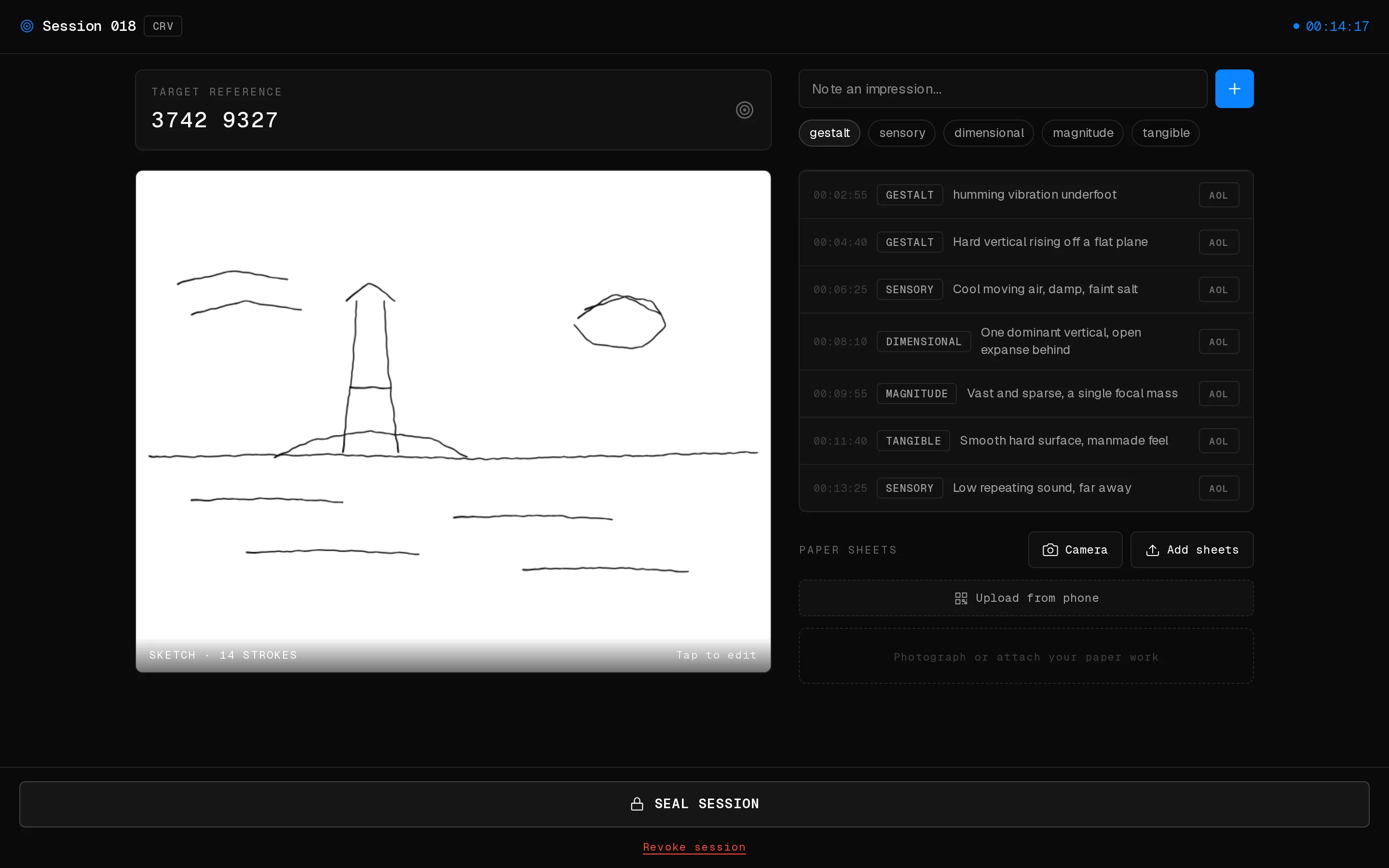
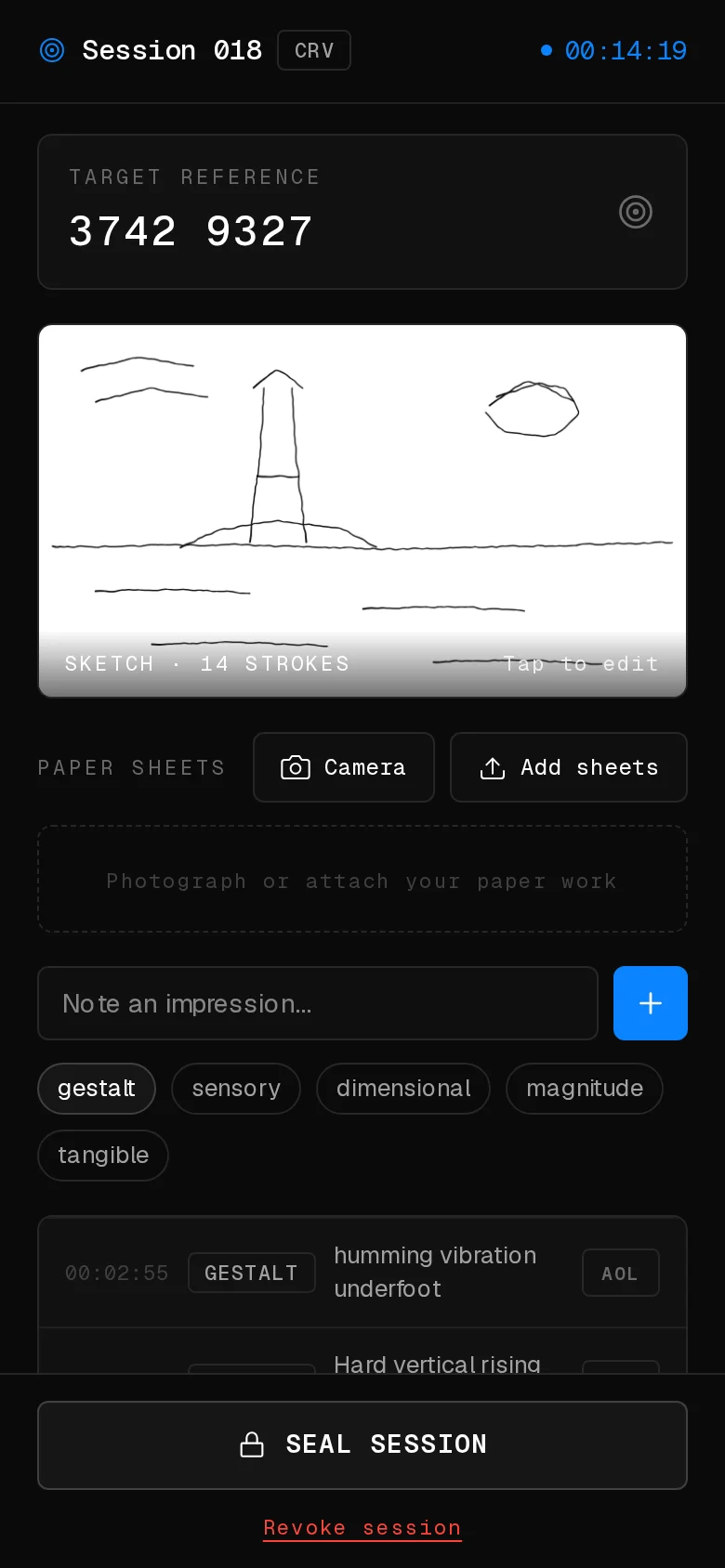
One capture surface per session: a vector canvas, categorized descriptors, photographed paper sheets. Strokes carry per-stroke time. Impressions carry capture time. The app enforces protocol, never method.
Sealing is one way. After seal the record is immutable: judging sees exactly what you recorded, and nothing can be added to it afterwards.
An undo never deletes. Removed strokes are flagged and kept, because an honest record includes its corrections.
Ranked blind, by peers who cannot know.
Sealed sessions are scored by other viewers as a rank-order lineup: the real target among decoys, shuffled server side. A judge sees slots and images, never which one is real. You never judge your own session.
Reveal is gated twice: at least three delivered judgments, and a waiting period of days. Whichever lands last releases the feedback, when it can no longer contaminate the record.
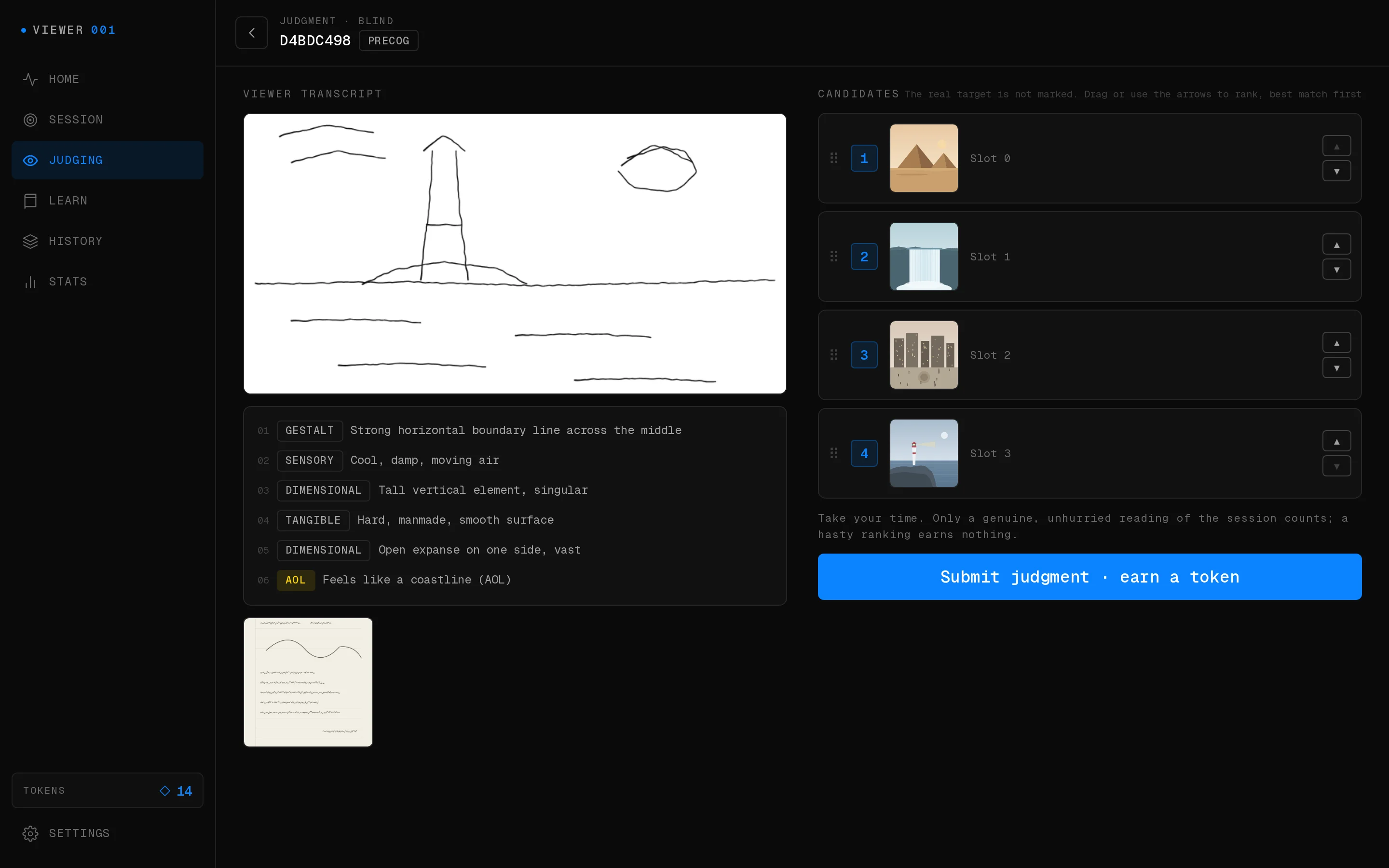
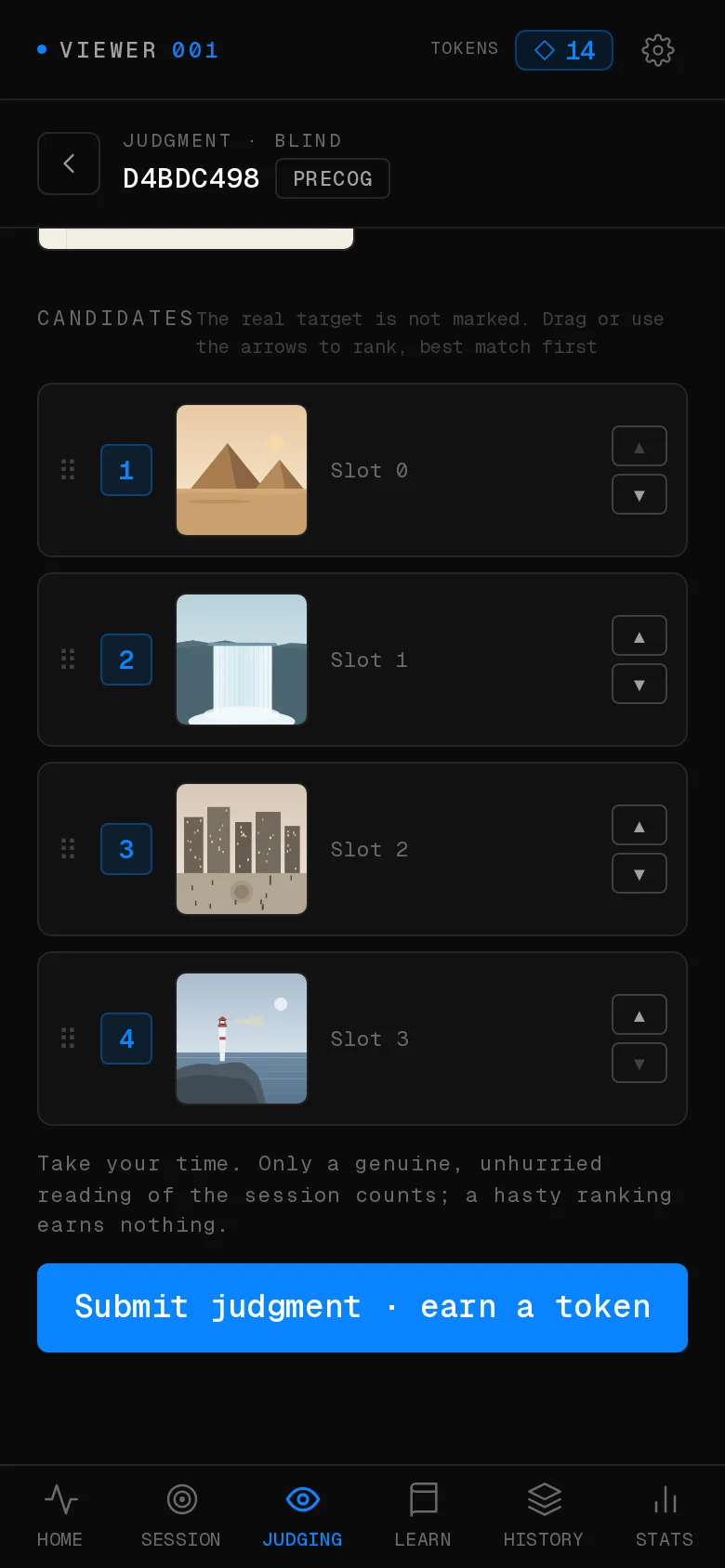
The lineup a judge sees. Which slot is real never leaves the server.
Nothing is for sale.
No subscription. No token packs. No paid tier. The cost of opening a session is a judgment, because peer judging is what makes the protocol run. Judge one session, earn one token, spend one token to open yours.
No streaks, no expiring tokens, no mechanics designed to pull you back. This is a design commitment, not a pricing strategy. The instrument is paid for with attention to other viewers' work.
A tip jar exists to help with running costs. A tip grants nothing in the app.
The ledger is append-only. Balances are computed, never edited.
Honest numbers, logged conditions.
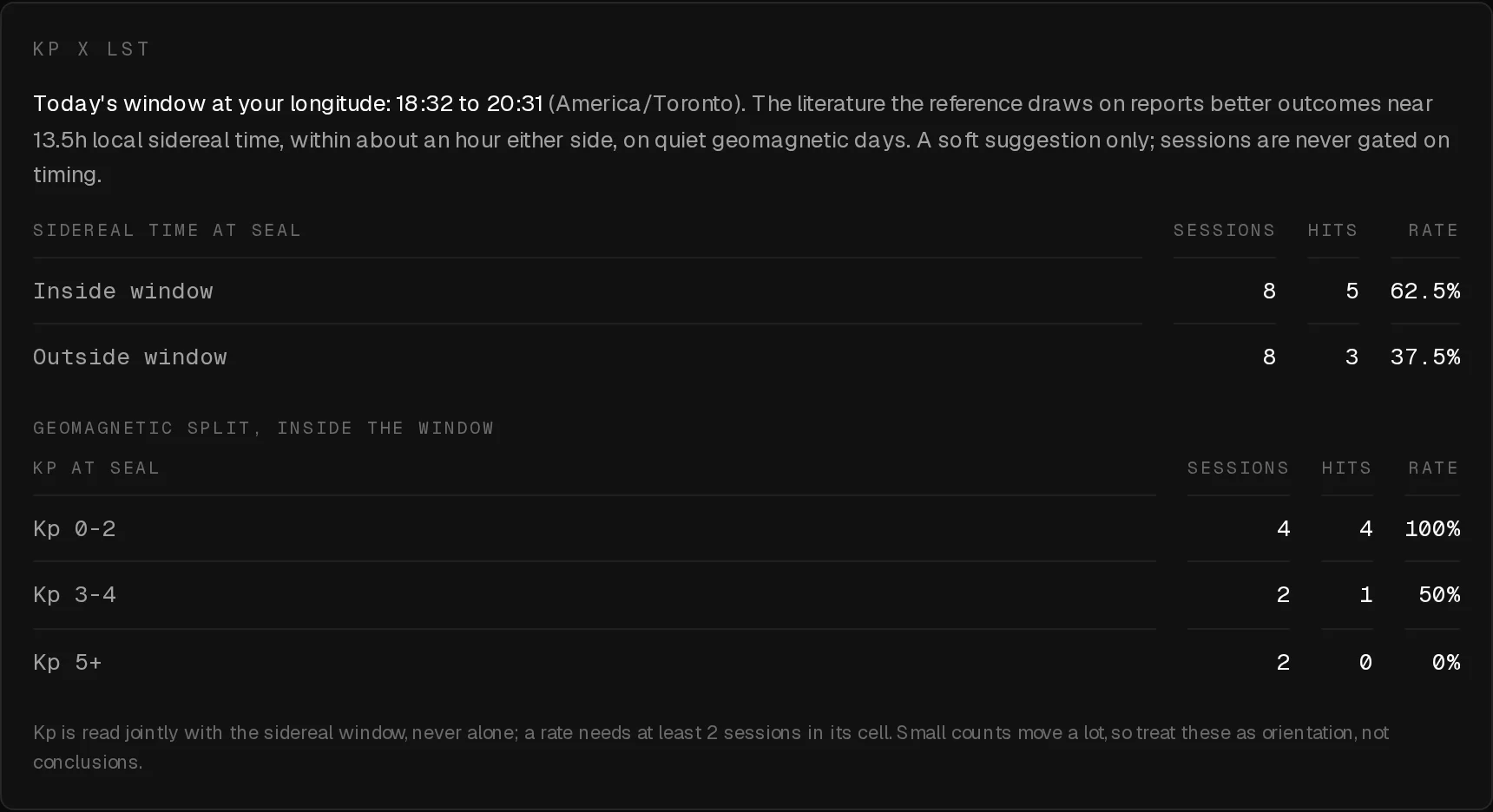
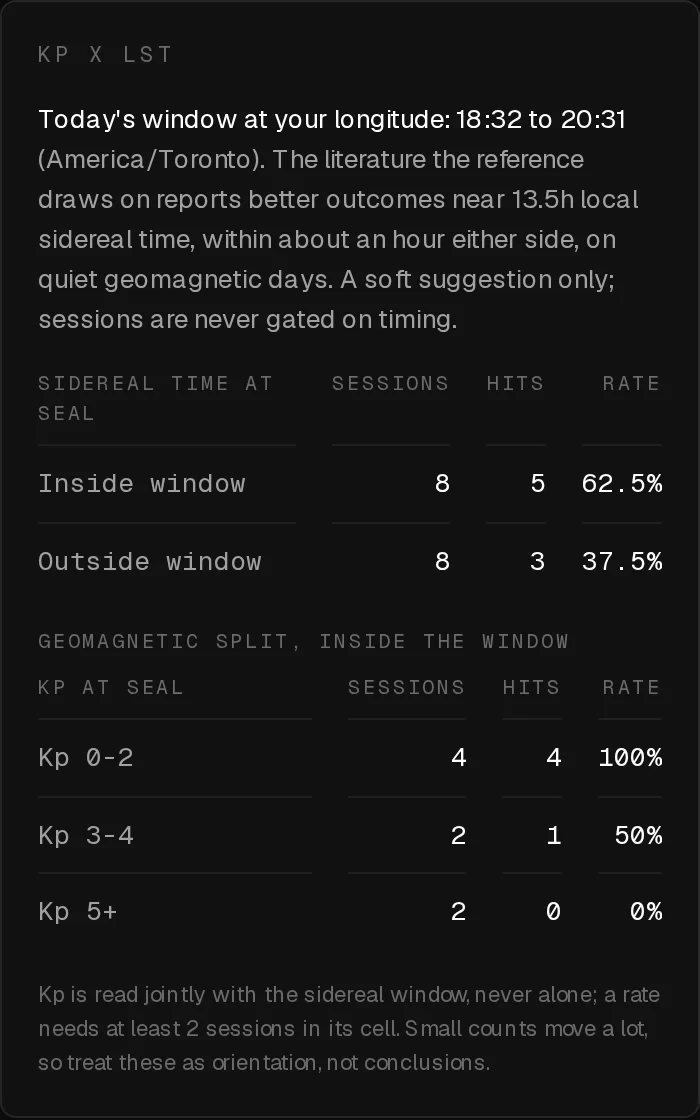
Every session records the geomagnetic index (Kp) and your Local Sidereal Time at seal. The stats engine reads them jointly, never Kp alone, around the 13.5h LST window the literature points to.
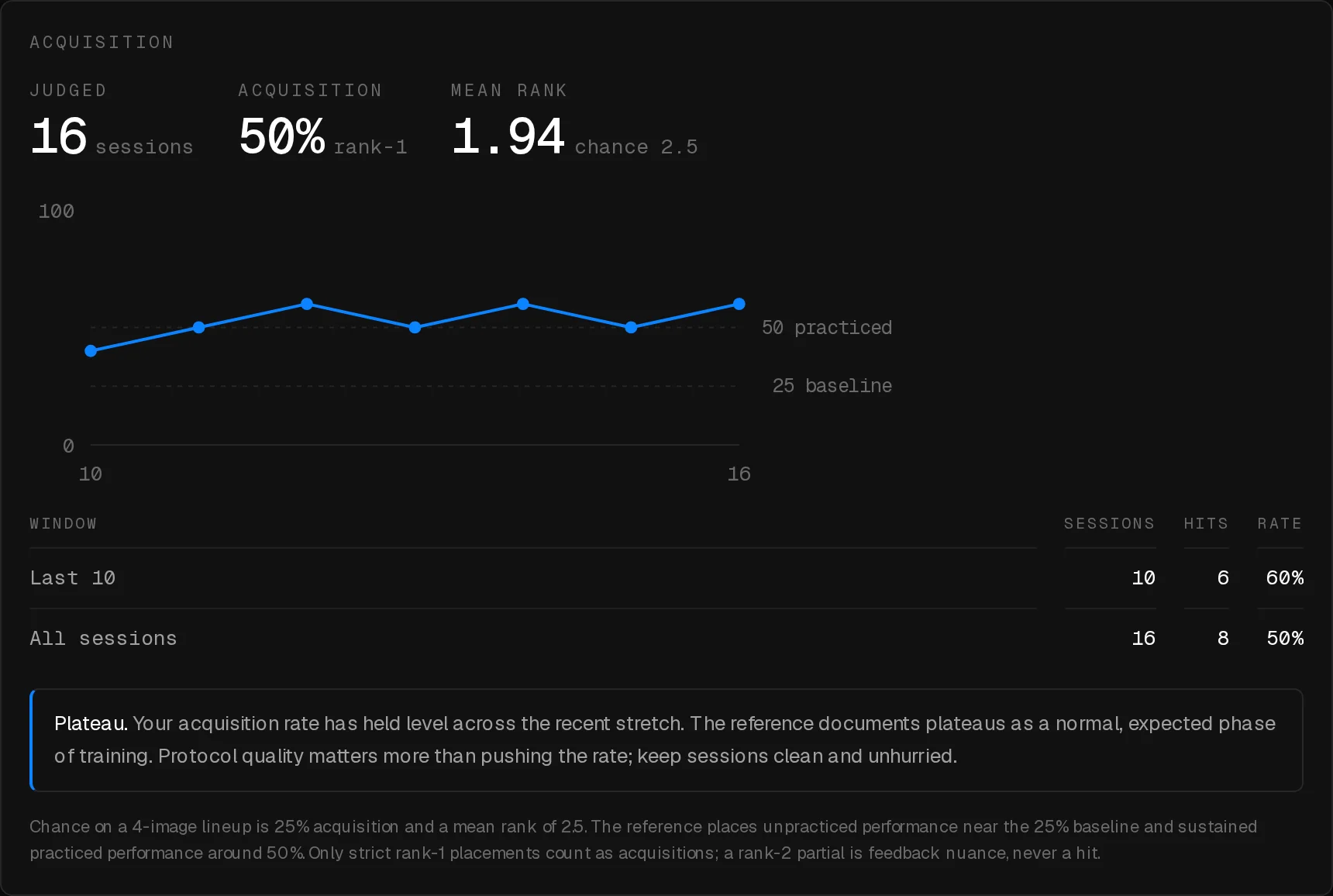
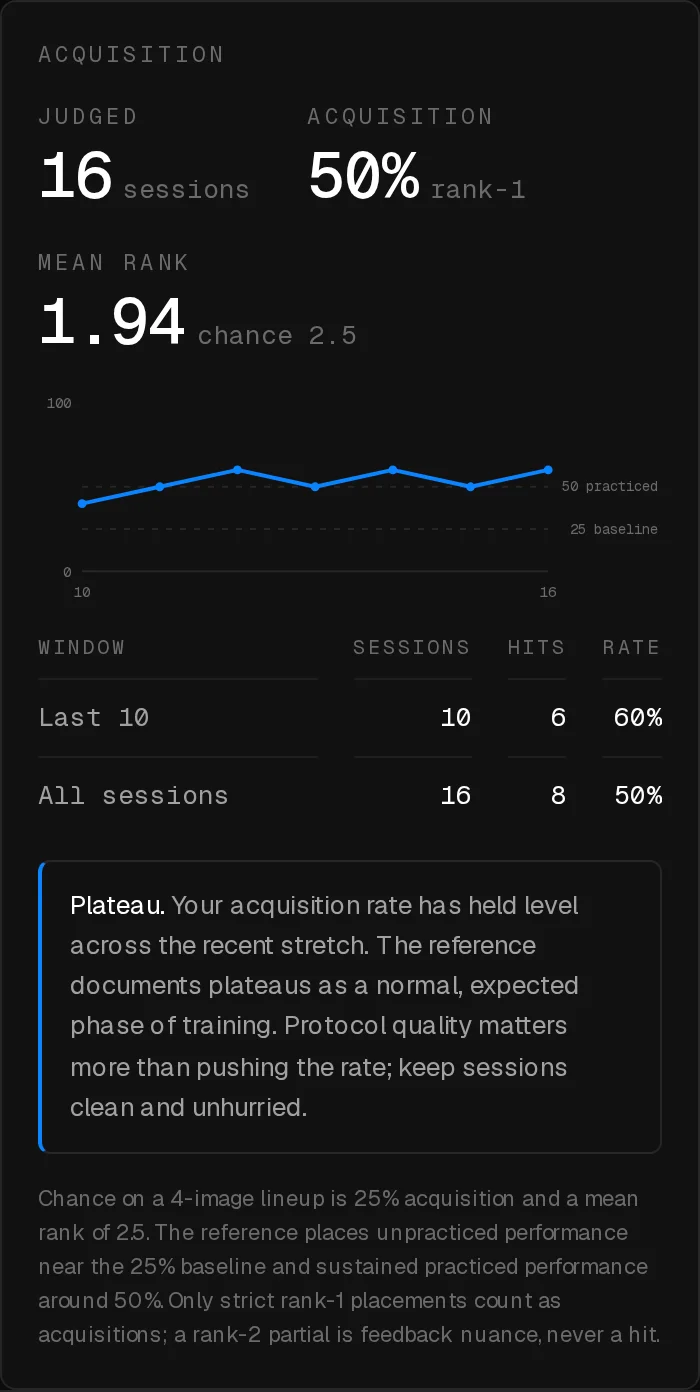
Scoring is strict. Only a rank-1 placement counts as an acquisition. Calibration bands stay fixed at the 25% chance baseline and the roughly 50% the reference reports for practiced viewers. No inflation, no streak bonuses, no rounding in your favor.
Rank is earned twice.
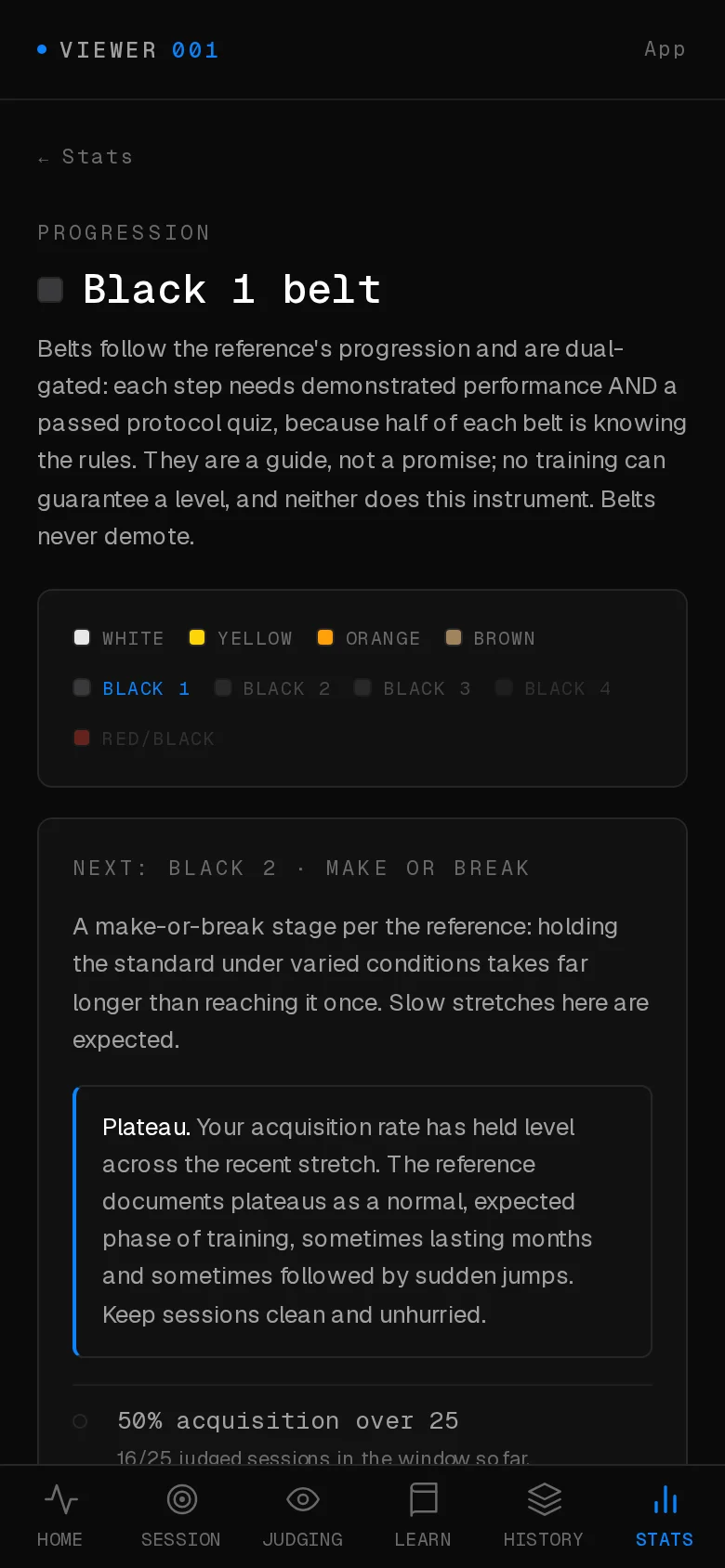
Each belt is dual-gated: demonstrated performance across a windowed stretch, and a passed protocol quiz, because half of each belt is knowing the rules. Belts never demote. None of it can be bought.
The stretches where nothing moves are in the manual too. A plateau is a documented, expected phase of training, not a failure state, and the instrument labels it as such on your own charts.
One book decides.
Every protocol decision in Viewer 001 resolves against a single reference: Remote Viewing Secrets: A Handbook by Joseph McMoneagle, Remote Viewer 001 of the U.S. Army's Star Gate program. Where a design question was ambiguous, the book won.
Read the source. The app enforces it.
Before the first session.
What is remote viewing?
Remote viewing is the production of information about a target hidden from the viewer, under conditions that rule out every ordinary explanation. The definition is procedural: what makes a result remote viewing is not how the impressions arrive, but the controls around the session.
How do I practice remote viewing online here?
Open a session and you receive a target ID: an arbitrary label that carries no information about the target. Record your impressions on one capture surface (sketch, timestamped descriptors, photographed paper sheets), then seal the record. Blind peers rank it against decoys, and the target is revealed after judging and a waiting period of days.
Is Viewer 001 free?
Yes. No subscription, no token packs, no paid tier. Opening a session costs one token, and tokens are earned by judging other viewers' sessions. A tip jar exists for running costs; a tip grants nothing in the app.
What is the McMoneagle protocol?
Viewer 001 resolves every protocol decision against one book: Remote Viewing Secrets: A Handbook by Joseph McMoneagle, Remote Viewer 001 of the U.S. Army's Star Gate program. Its controls are what the app enforces: the viewer is blind, everyone else in the chain is blind, the tasking carries no content, the record is sealed at termination, and feedback comes last.
What is the difference between CRV and precog mode?
In CRV mode the target is selected and sealed to your session before you begin, and you receive only its target ID. In precog mode no target exists while you work: it is drawn at random after your session is sealed. Both modes run under the same blinding, sealing and judging rules.
How is a session judged and scored?
Other viewers rank your sealed session in a lineup of four images: the real target and three decoys, shuffled server side, none of them marked. Only a rank-1 placement counts as a hit. With four candidates, chance is 25% per judgment, and you never judge your own session.
Does Viewer 001 teach a remote viewing method?
No. It enforces the protocol and stays silent on method. How you collect impressions (an altered state, a staged written structure, free-form notes) is yours. The public manual explains the protocol, and no account is required to read it.
Is AI involved?
Not in the pool and not in judging. Every target is chosen and described by a human against the reference's criteria, and every judgment comes from a person.
Does it work on a phone?
Yes. Viewer 001 is an installable web app for phone, tablet and desktop, with Apple Pencil support on iPad. It is available in English and French.